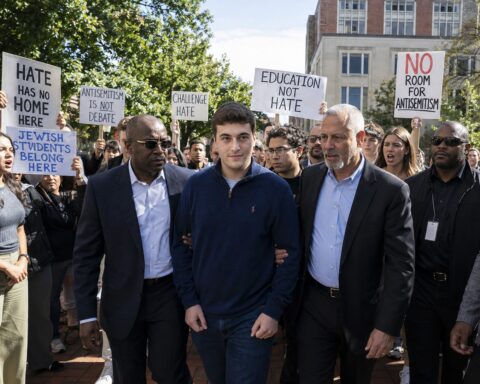
Occupy protestors rightly identify the City’s failings, but, as Terry Smith points out, the market itself is not the enemy.
I once proposed a short book, to be called How to Make Money out of Life Assurance. This would have read, in its entirety: “Don’t buy it, sell it.” Such disrespect for the City’s accepted wisdom found no takers.
Terry Smith was luckier. His book Accounting for Growth denounced some of the City’s favourite arithmetic as pure self-serving cant. Nowadays he runs a big financial company, but he still classes accepted wisdom as a contradiction in terms. In Guildhall the other day, he told a City gathering that the Occupy movement’s protesters might be right.
If they find fault with the way in which the markets have been operating, he agrees with them. He begins, as they do, with the banks. High street banking and investment banking are, to his mind, hopeless bedfellows, with divorce the only remedy. Their marital woes were made worse by securitisation — wrapping up loans in a parcel and selling them on: fine, until somebody opens the parcel.
Bonuses helped to keep the parcel going round. They could be designed to reward the performer and leave the risk with his paymaster. Too often, they were. For that, the blame lies with the business’s owners. They should not expect others to do their work for them.
Even so, to Terry Smith’s mind, they are on the wrong end of their bargains. They find themselves dealing with counterparties whose Chinese walls (as Nigel Lawson so nearly said) have chinks in them. They are asked to deal on terms which ensure that the value accrues to the other side. The hedge funds, routinely charging “two and twenty” — 2 per cent of the funds under management and 20 per cent of the gain, if any — have taken this principle to its conclusion.
For example: if you had invested $1,000 in Warren Buffett’s company half a century ago your stake would now be worth more than $4 billion. But if the great man, in those distant days, had been operating a hedge fund, he would now have the $4 billion and you would have the change.
The protesters may think the market itself is the enemy. If so, they have powerful friends on either side of the Channel. Eurocrats have always reckoned to know better than the Anglo-Saxons in red braces, and François Hollande, who may well be France’s next president, has his sights squarely trained on finance.
This is where Terry Smith parts company with Occupy. Blaming the bankers, so he says, will not solve our problems. Political gesturing may make them worse. What we need to do is to encourage the markets to work as they should — and when he says “we” he means the City professionals sitting uncomfortably in Guildhall, accepting the wisdom of all those around them.
It needed saying — and if he needs a text for his next sermon, drawn from the world of life assurance, I could offer to supply one.