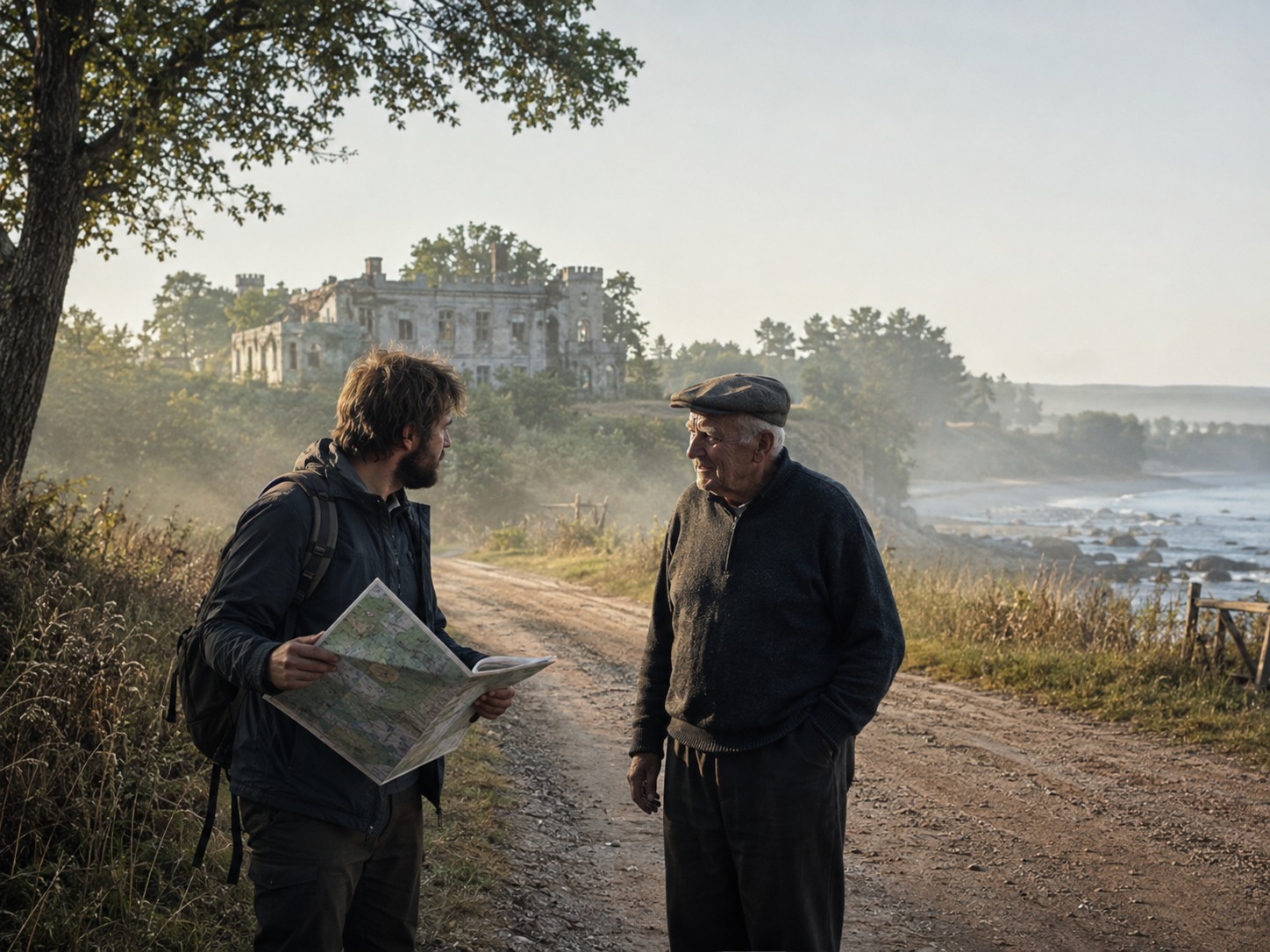
Although I do not much care for travel writing, there are (as with every literary genre) some exceptions: Patrick Leigh-Fermor for one, V.S. Naipaul for another. A new discovery for me is Jean-Paul Kauffmann. His latest work, superbly translated by Euan Cameron, is A Journey to Nowhere (Maclehose Press, £18.99). It describes a journey to Courland, the Latvian peninsula inhabited by the human debris of a history as picturesque and desolate as its windswept landscape.
Kauffmann is driven by an insatiable inquisitiveness about this Baltic backwater. As a student in the late 1960s, he fell in love with a beautiful bookseller at McGill University in Montreal. She turned out to be the daughter of two Courlanders who, like so many of their countrymen, had fled from the advancing Red Army and settled in Canada.
Her name was Mara. Kauffmann recalls their courtship: how attached she was to the distant land that she had never seen but still thought of as home; how writers such as Stendhal and Yourcenar kindled her interest; and how conversations about Courland as he stroked her hand overcame her reserve to reveal an unexpectedly passionate nature. After he returned to France, the lovers lost touch for more than 30 years.
But in 2001 his publisher forwarded a letter from Mara, now on the verge of grandmotherhood, outlining her life in the intervening decades. When Latvia regained its independence after the Soviet collapse, she had returned with her second husband, an American, to live in her ancestral homeland. Mara had not quite found what she was seeking: “In Canada, I felt I was a Courlander, but now that I live in Courland, I don’t see any Courlanders. I realise that the inhabitants have lost their identity. They’ll find it again one day, I feel sure.”
Kauffmann, too, seems unsure of this elusive identity, just as he is unsure what to think about his former girlfriend. She has read one of his books and signs her letter “with love”, but gives no address, thereby indicating that she has no wish to see him again. He even wonders if he met her on his travels in Courland, but that after so many years neither of them recognised the other. Now, he reflects, “Mara is like a scar for which there never was a wound.”
There is something haunting about this story within the story of Kauffmann’s journey, which is embellished by random encounters with more or less colourful and eccentric Courlanders, none of whom however has the charm of Mara. She belongs to Courland’s amnesiac present, yet evokes its exotic past — from the Order of Livonian Knights to 19th-century Jewish emigrants, fleeing Russian pogroms from the principal port of Liepaja; Baron Munchhausen concocting his fabulous adventures; the exiled Louis XVIII, last of the Bourbon monarchs; and Eduard von Keyserling, whose novels immortalised the doomed Baltic barons: Courland’s Chekhov. Kauffmann’s homage to his lost beloved leaves us all in his debt.
YARPP Thumbnails
YARPP Thumbnails