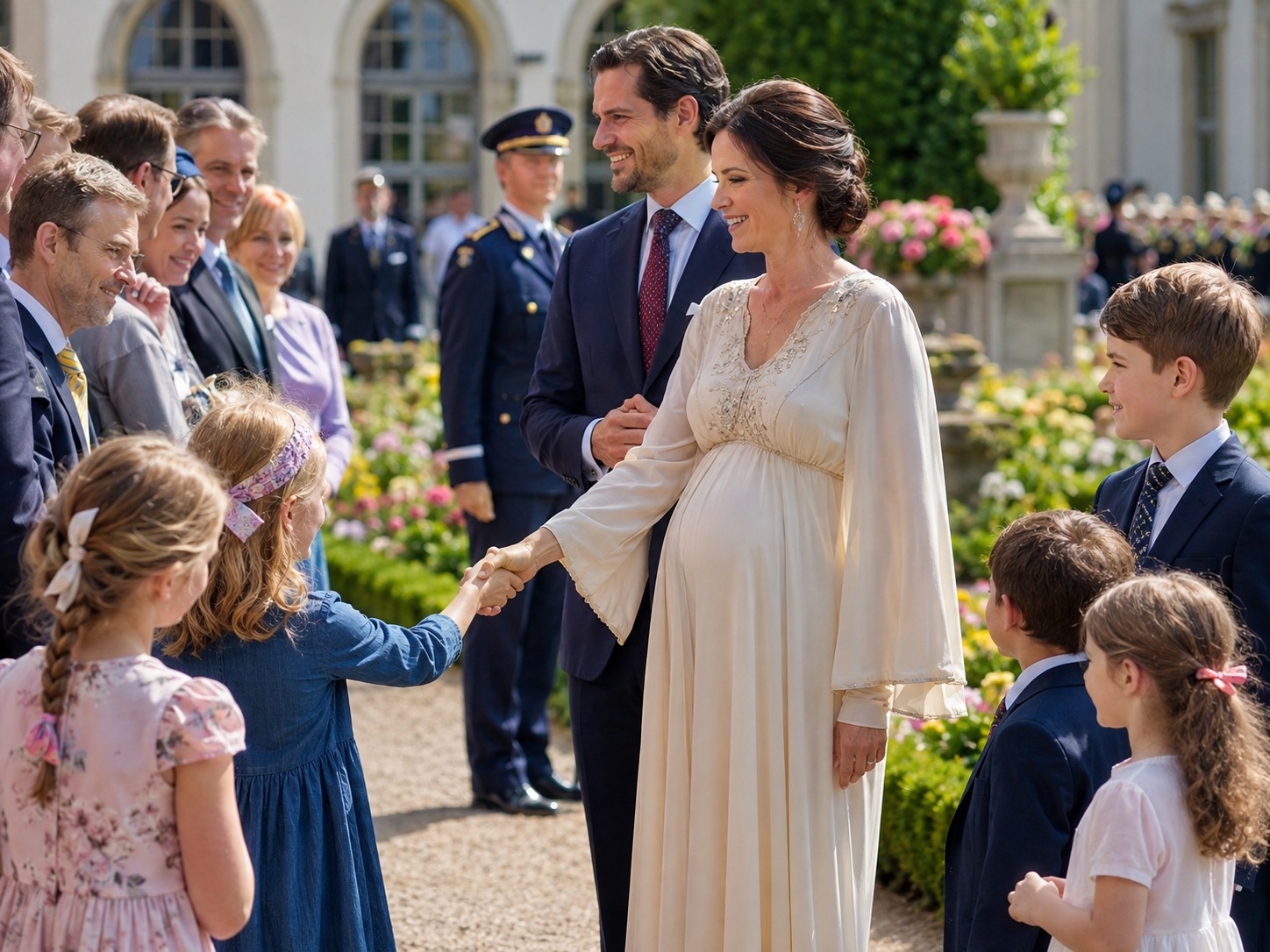
Tongue-tied: The Princess of Cambridge may have revealed the gender of Britian’s future heir while greeting her admirers
In March the Duchess of Cambridge took a walk around Grimsby, and when offered a teddy bear from a woman in the crowd was heard to say, “Is this for my d … ?” The uproar was immediate: “Duchess to have a girl” was beamed around the world. The potential importance of the d … and what it might stand for, cannot be overstated. For if a girl is born to the Windsors in July, not only will she be the first royal daughter in British history to take precedence over any younger brothers, but is also likely to strike a death blow to the whole principle of primogeniture. And this, if you believe in sexual equality, must be all to the good.
The Succession to the Crown Bill, soon to be the Succession to the Crown Act, decrees among other things that any royal boy born after October 28, 2011, will not precede his older sister in line to the throne. So far no great upheaval for the rest of us. Since each British title is governed by its own Letters Patent, and each is piecemeal (although the standard clause is that the title be passed through “heirs male of the body”), the Act does not even affect the aristocracy. Yet the fact that the monarchy is accepting the primacy of women, although it presents no legal precedent for anyone but the royal family, will have wider implications. Perhaps the first to take the Act as a call to arms will be disinherited girls. A likely example is the daughter of Baron Braybrook, Amanda Murray who, as the eldest of eight girls, would, as it stands, have to watch her father’s title go to a distant cousin. Before the bill was passed she remarked: “My poor father had no son, just lots of daughters. In this day and age, with supposed equality, why am I not allowed to inherit my father’s title?”
Now however, she has an example by royal appointment which says that girls should be just as eligible to inherit as boys. The hope is that this kind of thinking extends to the 16 Commonwealth countries that gave the bill their assent: Jamaica, for instance, where the bulk of property is still left to sons ahead of daughters.
But what will replace primogeniture for landed people? Traditionalists argue that if an estate, however small, is to survive it has to be kept intact, so France’s Napoleonic Code, where everything is divided equally, is not viable. Yet to leave all to the eldest child seems a little like replacing one tyranny with another, with age instead of sex the more politically correct deciding factor.
The sex of the royal baby, when it arrives in July, is crucial. If it’s a boy the legislation will have to wait for another generation to have any impact. But if it’s a girl, the times will start a-changing.
YARPP Thumbnails
YARPP Thumbnails