“There are some writers who have entirely ceased to influence others, whose fame is for that reason both serene and cloudless, are enjoyed or neglected rather than criticised and read. Among them is Scott. Yet there are no books perhaps upon which at this moment more thousands of readers are brooding and feasting in a rapture of silent satisfaction. The Antiquary, The Bride of Lammermoor, Redgauntlet, Waverley, Guy Mannering, Rob Roy, The Heart of Midlothian — what can one do when one has finished the last but wait a decent interval and then begin again upon the first…”
This was the opening of an essay by Virginia Woolf on The Antiquary, in The New Republic in December 1924, a century after the publication of Redgauntlet, Walter Scott’s last indisputably great novel. It is now almost two centuries since the first of his novels, Waverley, was published in 1814. Sadly, it’s probable that the claim made in the third sentence no longer holds good. Woolf’s “common reader” has, it seems, deserted the first master of the historical novel, ironically at a time when the genre is more fashionable than it has been for more than 100 years. All six of last year’s Man Booker shortlist were set in the past, with the winner, Hilary Mantel’s Wolf Hall as far back as the 16th century.
I still meet people who read and appreciate Scott, and the splendid new Edinburgh edition of his works has led to a reawakening of academic interest. Yet Woolf was probably justified in saying that he had “entirely ceased to influence” other writers, even 80 or 90 years ago. Certainly, it is likely that none of the authors on the Man Booker list owed him anything, consciously or unconsciously. It was different in the 19th century. Dumas and Hugo in France, Manzoni in Italy, Fontane in Germany, Tolstoy in Russia, and Thackeray — in Henry Esmond certainly and Vanity Fair probably — were all in his debt, as were Stevenson and Buchan in their historical novels. Hugh Walpole, in his Herries chronicles, was one of the last novelists to regard himself as a disciple of Scott. But though he was Woolf’s friend, he knew, to his dismay, that she didn’t think much of his books.
Historical novels continued to be written, and some were very good: Ford Madox Ford’s trilogy, The Fifth Queen, for instance, makes for an interesting comparison with Mantel’s award-winner, as does Buchan’s Tudor novel, The Blanket of the Dark. There were fine novels set in antiquity by Robert Graves, Naomi Mitchison, Rex Warner, Alfred Duggan and Mary Renault among others, while Evelyn Waugh thought Helena his masterpiece (or said he did). But by and large the genre fell into disrepute in Britain, historical novels being regarded as entertainment, not serious fiction. Many of the most popular writers who set their fiction in the past offered no more than that, good examples being the romantically fictionalised histories of Margaret Irwin, and that 1940s’ bestseller Forever Amber. Colourful swashbuckling novels pleased a public but were ignored or derided by serious critics.
Scott himself bears some responsibility for the disfavour with which the historical novel came to be regarded. His medieval novels, written for money and made from his wide reading, were more influential, more easily imitated than the novels set in the Scotland of the 17th and 18th centuries that are praised by Woolf. (Unaccountably, she omits The Tale of Old Mortality, one of the finest and most intelligent political novels in the language.) These medieval novels have their own charm. Ivanhoe especially, several times filmed, remains captivating and is, in John Buchan’s words, “a glittering pageant”. Goethe, entranced, called it “a wholly new art”. Quentin Durward, with its fascinating depiction of that extraordinary figure, Louis XI of France, can still delight.
Scott was never other than intelligent, and, even in these later novels his analysis of conflicting currents in history and of the clash of cultures is often acute and interesting.
But a great deal of what is on offer is no more than decoration. The past is a place where they may seem to do things more colourfully. And it is the colour and detail that his more feeble imitators took as the essential ingredients of the historical novel. He also failed to solve the problem of finding the right language for his characters to speak, so that they express themselves sometimes in what one might call ersatz medieval — “zounds” and “gramercy” — and sometimes as 18th-century ladies and gentlemen transported back in time. The result, especially in the works of his imitators, was what has been called “tushery” or “Wardour Street English”. His real distinction is to be found in the Scottish novels, more generally, in what Carlyle identified as his ability to remind us that historical figures were men and women of flesh and blood, not abstractions, and that events in the past were once in the future. This is something Robert Harris does successfully in his two Cicero novels, Imperium and Lustrum.
Scott wrote at a time when interest in history as a means of understanding the contemporary world was being born. He contributed to this and stood also on the threshold of one of the 19th century’s most significant features — the development of history as an academic study. The father of academic history, Leopold von Ranke, insisted on the autonomy of the past and sought to recreate it “wie es eigentlich gewesen ist” (“as it actually was”). This is the aim, or at least an aim, of the serious historical novelist, who sets out to offer more than entertainment. In Wolf Hall, for example, Mantel evokes the revolutionary decade of the 1530s, and her hero, Thomas Cromwell, is an emblematic figure precise ly because he represents a new way of thinking. Mantel uses him to show how a new England will take shape.
Why do novelists turn away from the present day to the past, and sometimes, like Harris, to the now far distant past? There is evidently no single reason. The writer may have become fascinated by some historical figure, as Mantel with Cromwell or Adam Foulds, whose The Quickening Maze was one of the six on the Man Booker shortlist, with the poet John Clare. Obsession with a particular period — the First World War, for instance — may suggest the theme for a novel. The author may wish to explore the past for its own sake, or to use it to point up the present. Harris’s Cicero novels certainly offer a vivid picture of late Republican Rome, but Harris has worked as a political journalist, and these books are also an examination of the nature and craft of politics, all the more effectively so for being divorced from immediate political concerns.
The past is more manageable and easier to grasp than the present. It rewards brooding, whereas the contemporary world shifts and defies reflection. To write a novel that deals with public affairs set in the present is to flirt with journalism. A comic novel or a domestic novel is a different matter. Comedy thrives on observing contemporary follies and fashions. The domestic novel may properly and successfully address the shifting social attitudes and moral codes of the contemporary world. But a novel with a public or political theme seems to require a degree of distance.
It poses other problems for the author. Trollope, writing his political novels in the mid-Victorian years, could acceptably give his Prime Ministers names of his own devising. But this is scarcely plausible in our news-dominated world. On the other hand, to introduce real politicians by their own names is not only to invite a libel action, it is improper. Real-life public figures may only be introduced into fiction under their own names when they are safely dead and have become historical. So the novelist who wishes to write on some public theme is well advised to set his book in the past. And, if it is the comparatively recent past, then he is also wise to follow Scott’s practice in his Scottish novels and allow real-life historical figures to be presented through the eyes of fully fictional characters. This makes for their verisimilitude while allowing them to be fictionalised themselves. Conversely, the further you retreat in time, then the more free you are to make fictions of historical figures such as Cicero and Thomas Cromwell.
Novelists go back in time even when, for future generations, their novels may not appear to be what we call “historical”. War and Peace is a novel featuring real historical events and characters (though the historical characters play a smaller part in the novel than the fictional ones). If it is possible to read it now without thinking of it as an historical novel (despite those chapters on the philosophy of history, which many wisely skip), this is because the events of 1805 and 1812 were nearer in time to Tolstoy than he is to us.
This raises the question: what qualifies a novel to be regarded as “historical”? I have written three novels that centre on events of the Second World War. All three span much of the 20th century (with a passage in one which goes back to the 19th), and all are written, or written in part, by a narrator from the standpoint of the 1980s. When I was working on them, I didn’t think of them as “historical novels” but, given that they are all retrospective, even though for my characters events now in the past were then in the present and looking to an unknown future, I suspect that this is just what they are.
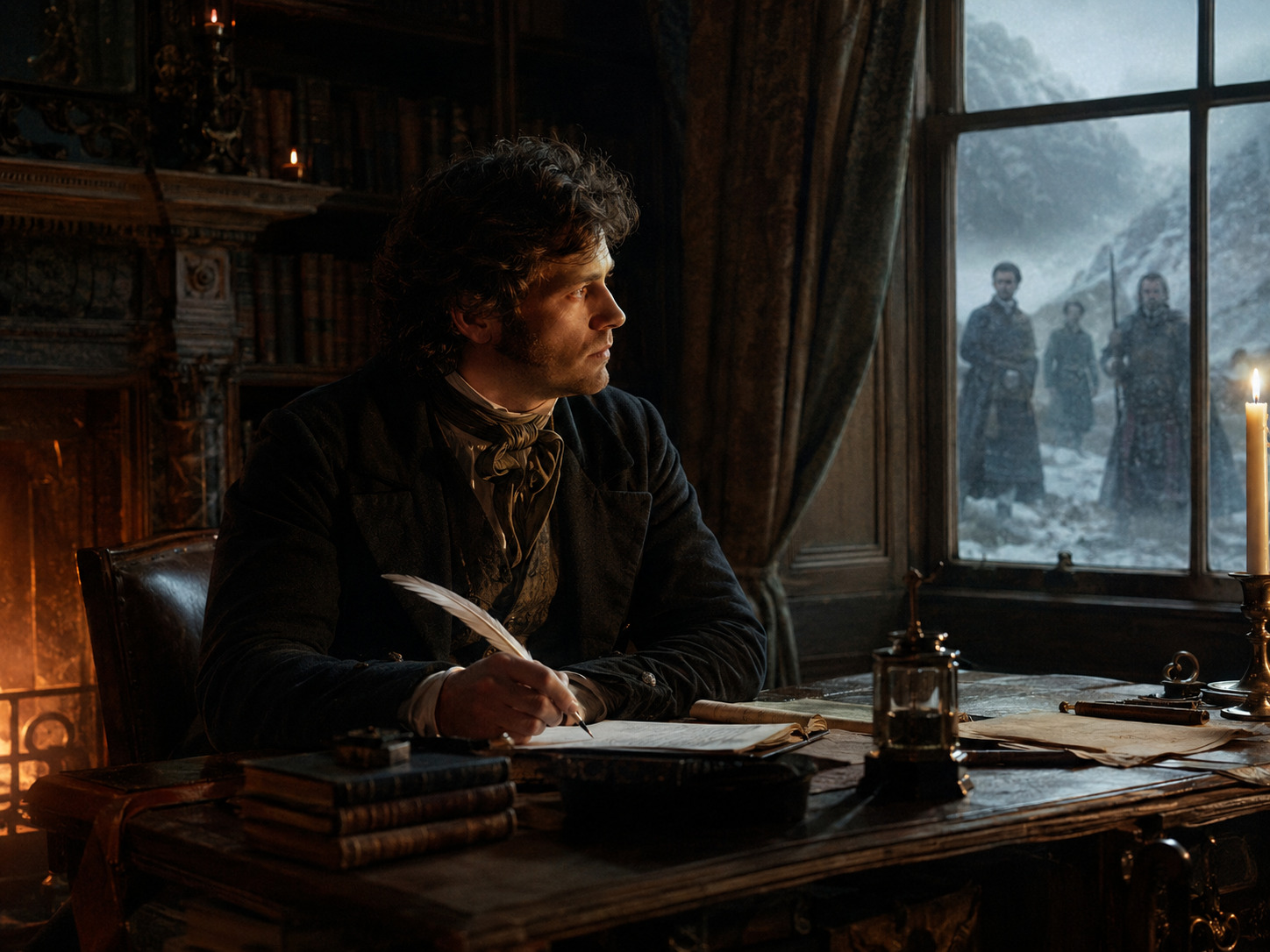
Scott gave Waverley, his novel of the 1745 Jacobite Rising, the subtitle ‘Tis Sixty Years Since (he should have said 70, since the novel was published in 1814, but he had written the first chapters ten years previously). The rising was only 26 years before his birth. His father was then a boy in his teens. As a child and youth, Scott knew men who had been “out”, as the word had it, in the rising.
The ’45 was history, certainly, but he was as close to it as anyone born in 1970 is to the Second World War. Scott drew on history to delight his readers, but also to show how present time has come to be what it is.
The past is, as L. P. Hartley said, another country where they do things differently, and exploring this difference is one of the things that may attract the novelist. There is a fine moment in Alfred Duggan’s novel about Cerdic, the first king of Saxon Wessex. Duggan has him as a Romanised Briton who, after misfortunes and adventures, becomes leader of a Saxon war-band. Early in the novel, he is reading Ovid in the courtyard of his father’s villa when word comes of a Saxon raid. He puts down the book and picks up his sword, and observes, casually, “I think that was the last time I read a book.” In that brief observation, the reader has a moment of illumination, catching the transition from Rome to Barbarism. This is something the novelist can do better than the historian.
But if the past is that other country, it is also a place that in certain respects is much like ours. Human nature does not change, though ideas and practices do. People are always subject to the same emotions: love, hate and fear. The Seven Deadly Sins offer the same temptations, and men are driven by ambition, idealism or the desire to exercise power, in any and every age. By turning to the past, free from the busy distractions of the present, the novelist gains the advantage of perspective.
There are essentially two sorts of novel, the open and the closed, even if many straddle the frontier that divides them. The closed novel is self-sufficient, free of the influence of public events. In the open novel, such events become characters in the action. The open novel is exposed to the winds of the world, its characters actors in history or victims of history. Given the difficulty of understanding the confusion and turbulence of the ever-changing present, it is natural that authors drawn to the open novel should turn to the past. Hence, in our present uncertainties, the attraction of the historical novel and the vogue it once again enjoys. Meanwhile, the Waverley novels that delighted several generations wait on the shelves to be discovered by those who have never known them, to be read again by those who, like Virginia Woolf, already love them.