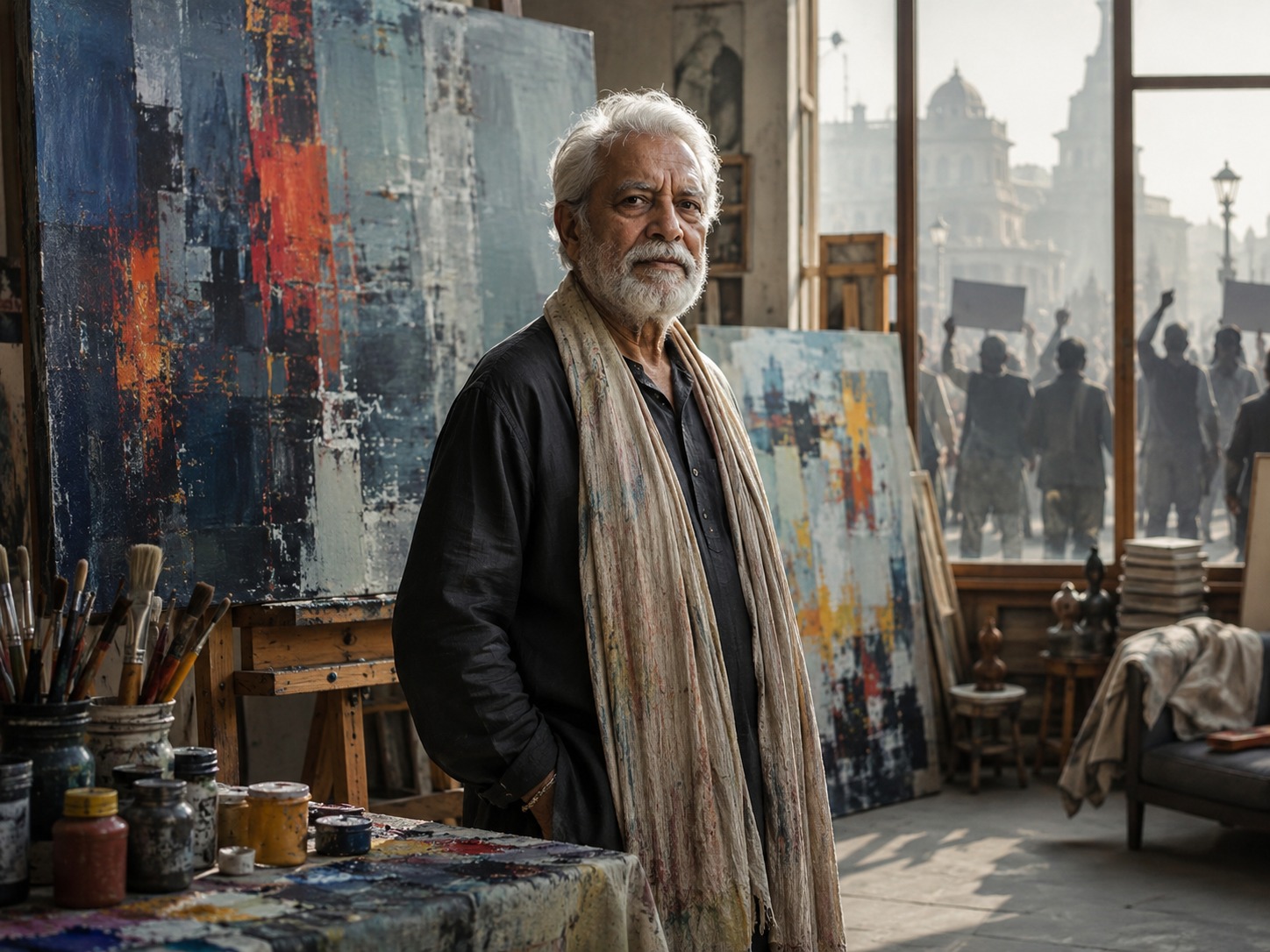
On December 7, a large circle of family, friends and admirers gathered in Dubai to celebrate the 97th birthday of M. F. Husain. They thought it was going to be his 95th birthday. So did he. But a diligent archivist had unearthed a birth certificate a few months before, and discovered that grand old man of Indian art was older by two years.
No one doubts that Maqbool Fida Husain is India’s grand old man of art. Western conceptual art is now so formulaic, so lost in mannerism and ironic self-reference, he may be the world’s greatest living artist, although writers tempt ridicule when they make such ostentatious claims. I would defy any critic, however, to deny that Husain embodies the spirit of his country. The struggles, optimism and glories of India flow through his work. Intelligent European collectors know it and buy him when they can afford to — the demand from Indian industrialists and Bollywood stars is so high you need to be very wealthy to bid and hope to succeed.
For at least half the year, he is in London. If you pass him in Mayfair, you will find him hard to ignore. He strides out from his studio to Shepherd Market in bare feet or socks — he does not wear shoes, whatever the weather. Often he carries an oversized paintbrush, just to make sure that the curious can guess his trade correctly. Yet I would guess in turn that most people in Britain who think of themselves as cultured know nothing of him. In part, the ignorance is the result of the parochialism of intellectual journalism in this country.
But our shallowness is not the only reason for Husain’s obscurity. He is a marked man. Any gallery that shows his work runs a risk. London’s Serpentine Gallery included a selection of his paintings in a wider exhibition of contemporary Indian art in 2008. Strange though it once would have seemed, its staff deserved praise for their bravery as well as their good taste.
In 2006, the Asia House cultural centre in Marylebone tried to give the British public the first major solo exhibition of Husain’s work. Threats from protesters closed it within days. Even though the Indian High Commissioner opened the show, they denounced Husain as an enemy of the Indian nation. Husain offended all Hindus, they cried. His work was pornographic and blasphemous. “The defamation of our Dharma in such a manner cannot carry on.” A vandal sprayed paint on his works. The possibility of violence terrified the exhibition organisers, and they backed away from a necessary confrontation with censorious extremism.
In India, Husain’s position is worse. Hindu militants have attacked his home and galleries showing his work. For almost a decade, India’s censorship laws, which allow the prosecution of anyone who threatens communal harmony, aided and abetted them. Far from promoting a happily diverse multicultural society, the laws of what is nominally the world’s largest democracy have allowed extremist Hindus to compete with extremist Muslims in tit-for-tat censorship campaigns. Unwittingly, the old man has become a player in the modern game of manufacturing offence. Sectarian politicians have used him to keep their supporters in a useful state of religious fury, a splenetic condition that delivers many votes to unscrupulous operators at election time.
His religion is the only reason why Husain is a target, incidentally: no other explanation makes sense. He was born into a Muslim family in Maharashtra in 1913, and his career as a self-taught artist began under the Raj.
His family moved to Bombay when he was in his teens, and he started out as a painter, going door to door to paint portraits for a shilling. “But what I discovered was that everyone, regardless of their looks, wanted to have their cheeks rosy. I could not do all these rosy cheeks, so I decided to paint Bollywood cinema hoardings instead.”
He painted his posters for nearly 20 years, scaling scaffolding and sometimes sleeping on the pavement. He didn’t mind. “I loved it, that street life. All art in India is viewed as celebration. That is what I’ve tried to put into my work.” Husain’s friends tell me that he travelled round India, and when he ran out of money, he laid out his drawings on railway station platforms and invited the public to pay what they wanted for them.
He was well into his thirties when Jawaharlal Nehru told the Constituent Assembly of India in New Delhi on the night of August 14-15, 1947: “At the stroke of the midnight hour, when the world sleeps, India will awake to life and freedom. A moment comes, which comes but rarely in history, when we step out from the old to the new, when an age ends, and when the soul of a nation, long suppressed, finds utterance.”
In 1948, Husain joined the Bombay Progressive Artists Group, which greeted independence with the cosmopolitan project of making a new art for a new country by combining Indian traditions with the Western avant-garde. He has stayed true to the progressive promises of the 1940s all his life. German expressionism and the modern movement influenced him, and Western critics called him the “Indian Picasso”, but he never lost his ability to straddle high culture and popular culture simultaneously, which is as good a definition of greatness in art as I can find.
In his paintings, gorgeous Bollywood stars — for whom he still has an appreciative eye, even at this late stage in his life — appear alongside gods and goddesses of the Hindu tradition. “For me, India means a celebration of life. You cannot find that same quality anywhere in the world,” he told an interviewer in 2008 when he was well into his nineties. “I never wanted to be clever, esoteric, abstract. I wanted to make simple statements. I wanted my canvasses to have a story. I wanted my art to talk to people.”
All India’s religious traditions moved him. His family were from the Sulaimani Bohra branch of Shia Islam, which in India had absorbed many Hindu beliefs. His mother died when he was young, and his father sent him away from home when he was a teenager.
“I used to have terrible nightmares when I was about 14 or 15. This stopped when I was 19. I had a guru called Mohammad Ishaq — I studied the holy texts with him for two years. I also read and discussed the Gita and Upanishads and Puranas. This made me completely calm.”
All of which is a long way of making a simple point. Husain is from the roots of India: an artist from “the soul of the nation”, to use Nehru’s phrase. He has painted for longer than the India republic has existed, and tried to tie its present to its past through his work.
Until he was close to 80, the idea that he had no right to include himself as a part of the long tradition of Indian art and thought because he was a Muslim would have struck him and all who admired him as inexplicable, as would the notion that there was anything offensive about his nudes.
You only have to visit the temple of Lakshmana at Khajuraho to see the erotic strain in Indian culture. The presence of naked gods and goddesses tells the visitor that they are far from the taboos of the Abrahamic religions. Hinduism bears partial responsibility for the many crimes of the caste system, but its admirers defend it by saying that because it has no prophet or pope it has room for those who believe in thousands of gods or none. “You can cover up your goddess in the finest silk and jewellery,” wrote Salil Tripathi, a sympathetic observer. “Or you can watch her naked. You can look at the beauty of her face and admire the divinity of her halo, a sari wrapped around her, and her face made up like a Bollywood queen. Or you can see her with ample breasts heaving, her luscious lips parted seductively carved, her thighs wrapped in supreme sexual ecstasy around an athletic god or even goddess — carved for eternity on the walls of a Hindu temple…At least that’s the theory, and it has been the practice in large parts of India for thousands of years.”
The sculptors of the Tantric and Shaktism cults openly celebrated eroticism. Others placed erotic carvings on the outer walls of temples not to excite visitors but as a reminder that they should leave their desires behind before they entered. More often, artists used nudity in religious painting and sculpture to symbolise purity. Their work carried no more sexual charge than the nudity of the sadhus who wade into the Ganges at Kumbh Mela.
Husain’s sketch of Saraswati, the goddess of learning, did not compare with temple carvings of goddesses wrapping their thighs around gods. You could not even call the drawing a fully realised nude. Saraswati sits cross-legged beside a lute holding a lotus flower above her head. There is nothing erotic — let alone pornographic — about his stylised white-on-black sketch, in which only contours, not detailed physical features, are evident. Husain’s goddess is pure to the point of being ethereal.
He drew her in the mid-1970s. No one complained. In 1996, a Bombay art critic included the sketch in a book on Husain. A writer on a sectarian Hindu monthly picked up a copy, saw the line drawing of Saraswati and decided to create a scandal out of nothing. “M. F. Husain: an Artist or a Butcher?” ran the headline above an article accusing the artist of insulting Hindus. The provocateur had picked the right time to start a culture war. By the 1990s, religious parties and sectarian militias had infested the supposedly secular and multicultural Indian state. They wanted — they needed — to inflame their supporters and, if they could not find real provocations, they were happy to invent them.
The leaders of Shiv Sena, a thuggish bunch of religious rabble-rousers, controlled Husain’s Bombay. They saw a copy of the article and instructed the police to file charges against him. Three days later, Hindu activists stormed a gallery in Ahmedabad showing his work and trashed his paintings.
Husain’s enemies had thrown him into the self-pitying and vicious world of Hindu sectarianism, whose malignancies the West should treat as a warning.
At the heart of multicultural theory lies a trap. Of all the reasons to be wary of unelected religious leaders asking the state to suspend freedom of speech to spare their tender feelings, not the smallest is that selective censorship leaves liberals with no argument against sectarians from the dominant denomination or ethnic group. In India, multiculturalism has led to the majority — or rather demagogues claiming to represent the majority — to behave as if it were a persecuted minority.
The various Hindu sectarian parties claimed that the descendants of India’s former Muslim masters still dominated the country. They noticed that in 1988 Rajiv Gandhi’s Congress government had banned Salman Rushdie’s Satanic Verses to please Muslim sentiment. Gandhi had also agreed to exempt Muslim men from paying the alimony to divorced wives that the secular law demanded, while not allowing Hindu men to benefit from the cheap rate authorised by sharia. Look, cried the Hindu sectarians, look at how the elite panders to the minority while penalising the majority.
The worst thing one could say about the Hindu nationalist charges was that they were true. By departing from equality before the law and universal principles, Gandhi had left India with no argument against sectarianism in whatever form it came. Hindu sectarians saw an opening and poured through it. They told the mass of Indians that they remain the victims not only of their former Muslim conquerors but of the former British conquerors too. The Raj’s final imposition on India was to indoctrinate Nehru and his anglicised, British-educated contemporaries with alien ideas about the need for a democratic and secular constitution, they maintained. Like militant Islamists and so many pseudo-leftist Western academics, Hindutva nationalists damned human rights, including the right to free expression, as colonial impositions.
Bal Thackeray, Shiv Sena’s leader, showed where the rejection of secularism led, in one of his many declarations of admiration for that ultimate cultural relativist, Adolf Hitler. He announced that Hindus must “shake off their stupor” and consider protecting their civilisation and culture. “If telling it like it is makes one a Nazi, I say: Fine, better that than the spineless, deaf, dumb, numb and blind state exalted as Nehruvian secularism. I wouldn’t even spit on it.”
Thackeray and the many Hindutva politicians like him insisted that Hindus were put upon and cozened. To end the injustice, they must free themselves from their former oppressors and become a force the world must reckon with.
Hence the destruction of the Ayodhya mosque, allegedly built by the conquering Mughals in the 16th century on the site of a Hindu temple, and the slaughter of thousands in the communal riots that followed. Hence the threats to the lives of historians who say that India has always been an amalgam of cultures, religions and ethnicities, or point out that some Hindu princes were as keen on sacking Hindu temples as the Mughal invaders were. And hence the campaign to persecute Husain.
As soon as Shiv Sena filed lawsuits against him, Husain had to absent himself from a celebration in the city of the Progressive Artists Group. If he had attended, the police would have arrested him for “disturbing communal harmony” — and there was a chance a religious mob might have killed him too. A group of young artists unfurled a banner at the party saying, “Husain, we miss you”, but other guests were unimpressed when a Western collector insisted that they speak out on Husain’s behalf. “Why doesn’t he understand?” said one artist’s husband. “This is like asking us to speak out in Berlin in 1936.”
As so often, the Hitler comparison was an exaggeration. However, given Thackeray’s pronouncements, you can see why he reached for it. Fanatics threatened Husain and all associated with him with violence. They destroyed his paintings at every opportunity. When a TV network asked its viewers whether Husain should receive India’s highest honour, youths from the Army of the Hindu Empire stormed the studios. In 1998, other militants attacked Husain’s Bombay home and wrecked it. Thackeray justified them and identified with them. “If Husain can step into Hindustan, what is wrong if we enter his house?” He was redefining India as “Hindustan” and turning Husain into an enemy alien in his own city.
At some level, the Thackeray clan may have understood that it was cynically whipping up a mob. Vipul Patel, Husain’s friend and adviser, told me that he was in a meeting with Thackeray’s son and political heir when Husain walked in, unexpected and unannounced. The sectarian did not start screaming but was slightly in awe of the artist and treated him with the utmost politeness.
The logic of retaliatory sectarianism could not be gainsaid, however. It dictated that when Islamists offered a reward to anyone who would kill Danish cartoonists who had offended them, Hindutva politicians offered a reward to “patriots” who would chop off Husain’s hands.
Not that Islamists could leave Husain alone either. They turned on him for directing a film in which an actor sang a song to an actress whose lyrics included words from the Koran.
A dirty mind is a perpetual feast, and once they started looking for reasons to be offended, sectarians found them everywhere. Husain painted a nude woman whose body curved around the map of India. Hindutva activists denounced the severe image as pornographic and claimed he was insulting Bharatmata (Mother India). In truth, Husain had made the painting severe, as it was his contribution to a charitable campaign to raise money for the victims of the civil war in Kashmir. As might have been expected, the fact that the aid was going to a largely Muslim population made his opponents angrier still.
They used black propaganda tactics against him. They renamed an untitled line drawing of the goddess Durga with a lion, which even the most sexually deprived or depraved among the gallery-going public could never find stimulating, and pretended Husain had called it Durga in union with a lion. They could then accuse him of producing blasphemous pornography, although it is far from clear from the picture if sexual union of any kind is taking place.
They passed over what he had painted and demanded to know about the paintings he had never painted. Why did he not paint Muhammad? Why did he paint nudes of Indian goddesses but not of the Prophet’s favourite wife Aisha? On the internet, his enemies contrast his abstract nudes of gods and goddesses with his fully-clothed portraits of his wife and daughter and Muhammad’s daughter Fatima. “Hussain depicts the deity or person he hates as naked. He shows Prophet’s Mother, his own mother, daughter, all the Muslim personalities fully clothed, but at the same time Hindus and Hindu deities along with Hitler are shown naked. This proves his hatred for the Hindus.”
India’s lawyers and politicians helped at every stage of the campaign of harassment. India and America are the world’s dominant multicultural democracies. But whereas America’s founding fathers wisely protected free speech with the first amendment, India’s founders believed in 1947 that censorship could promote national unity, as many politically-correct European politicians and bureaucrats believe today.
Article 19 of the constitution allows Indians free speech — but then adds opt-outs to allow censorship to protect “the sovereignty and integrity of India, the security of the State, friendly relations with foreign States, public order, decency…” Article 295 of the criminal code penalises “deliberate and malicious acts, intended to outrage religious feelings or any class by insulting its religion or religious beliefs”.
For good measure, Article 153 mandates the punishment of those who promote “enmity between different groups on grounds of religion, race, place of birth, residence, language, etc, [by] doing acts prejudicial to maintenance of harmony”.
The courts and the police, who never seemed to be on hand when criminals attacked art galleries, besieged Husain for more than a decade. The enemies of the secular Indian state were able to use its laws to undermine its principles. Censorship was not promoting harmony, let alone the interests of justice, but allowing sectarians to pick grievances out of thin air and order their goondas to avenge imagined wrongs. It took until 2008 for the Delhi High Court to throw out all of the hundreds of criminal charges against Husain, and warn: “In India, a new puritanism is being carried out in the name of cultural purity, and a host of ignorant people are vandalising art and pushing us towards the pre-Renaissance era.”
By then, Husain had had enough. In 2010 at the age of 96, and after years of exile, he renounced his Indian citizenship. Speaking with sadness but not bitterness, he said: “I have not intended to denigrate or hurt the beliefs of anyone through my art. I only give expression to the instincts from my soul. India is my motherland and I can never hate the country. But the political leadership, artists and intellectuals kept silent when Sangh Parivar [Hindu nationalist] forces attacked me. How can I live there in such a situation?”
India must carry the shame of being the first country to ban The Satanic Verses, the work of its greatest novelist, and of following up that miserable achievement by driving its greatest artist into exile.
Why pick on Husain for sketches no one found disturbing when he first released them? Read his accusers, and they cannot justify their charges of blasphemy or obscenity. How can they when Husain’s paintings are not remotely pornographic but part of a deliberate attempt by the artist and his contemporaries to continue Indian traditions?
Husain’s real offence was to be born into a Muslim family almost 100 years ago and to defend Nehru’s secular dream. That was it. That was all his attackers needed. They wanted to feed their supporters a diet of outrage, and needed to supply them with targets for their rage. The identity of the target was irrelevant. If they had not gone after Husain, they would have gone after someone else. In the new, pure India they yearn for, a Muslim cannot be a true Indian, or indeed in Husain’s case live in India as a citizen. Any Muslim or any historian they could accuse of being a socialist, communist or relic of British liberalism would do.
Well, how lucky we are that we do not suffer from versions of India’s censorship laws here, and how proud we should be that we could offer Husain a sanctuary in London.
But we are not so lucky, and there is no cause for pride. Go back to the forced closure of the Husain exhibition in 2006. The reaction to the attack on intellectual freedom in the heart of a city that boasts of being a great cultural capital told you all you needed to know about the spread of the enfeebling dogma that society must appease any religious group that can claim offence and threaten violence. There was no reaction. The artists and intellectuals who are usually so keen to write round-robin letters to the press denouncing this policy or that injustice stayed silent. Journalists and politicians bit their tongues, too. They tacitly accepted the tyrannical proposition that if a writer or artist failed to show “respect”, then he or she must suffer the consequences. The denial by fanatics of the right of the public to see the work of a major artist did not warrant one paragraph in all the news-in-brief columns of the daily newspapers.
The closure of Husain’s exhibition shows that we have no right to feel superior to India. The West has quietly accepted a new blasphemy law. It is not a law that has been debated by congresses or parliaments. No legitimate authority has spelt out its limits in a statute book. No judge protects defendants’ rights to a fair trial. No jury insists that they must find the accused guilty beyond reasonable doubt before conviction. It is enough that some know-nothing thug somewhere deems that a writer or artist had insulted him and his god or gods, and has the means, motive and opportunity to threaten retribution.
YARPP Thumbnails
YARPP Thumbnails