What Putin Wants
Alarmingly, there are credible Western voices advocating a grand bargain with Russia
Counterpoints Russia
16/12/2014
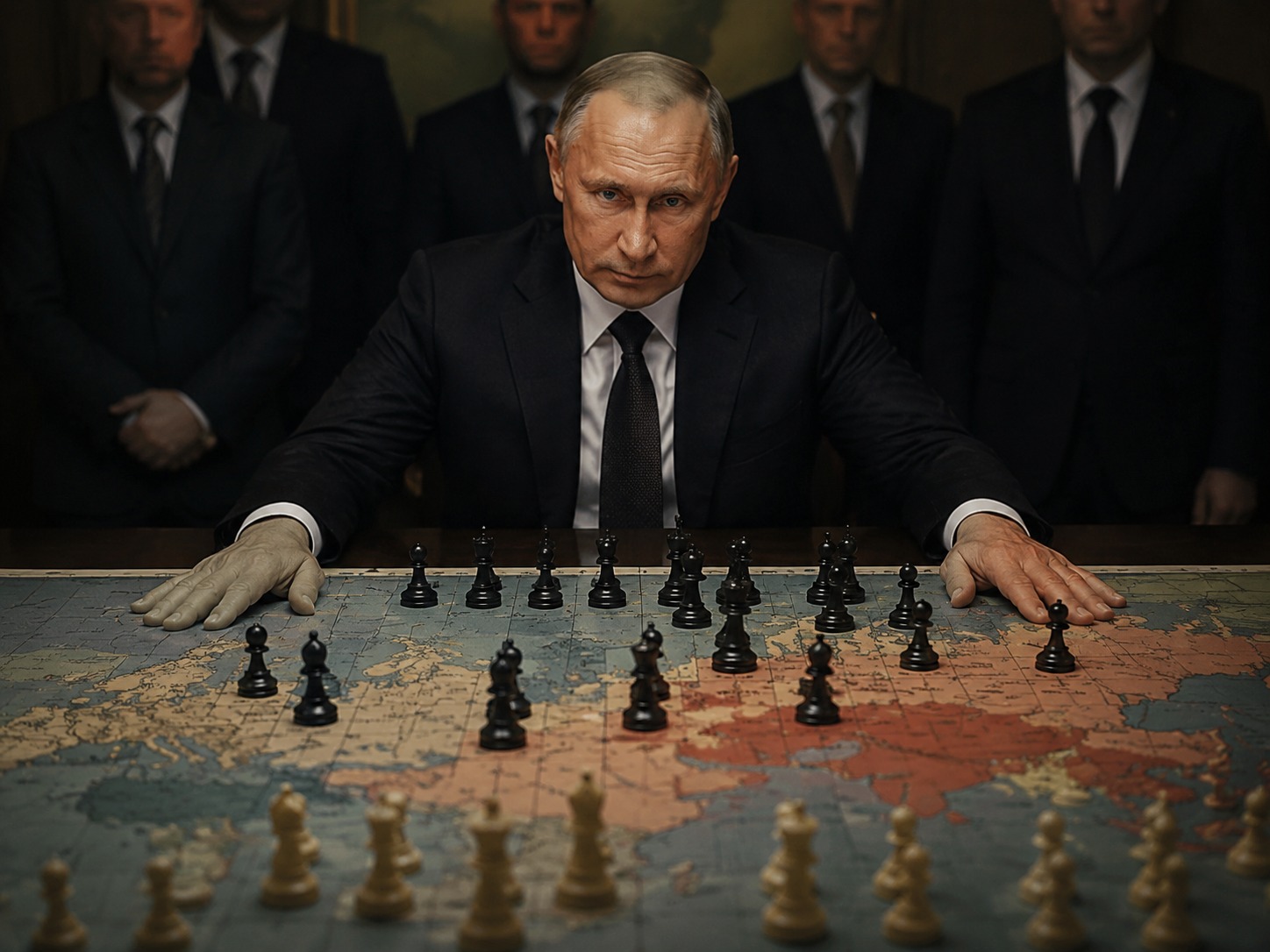
During the Cold War, Senator Henry Jackson suggested that the “Russians are like a burglar going down a hotel corridor, trying all the doors. When they find one unlocked they go in.” While Vladimir Putin is certainly an opportunist, dismissing his actions as adventurism fails to acknowledge the seriousness of his threat. His unrepentant State of the Union address warned Russia of hard times ahead. It appears that Russia could continue in a state of decay for some time. As we stagger towards the end of the first wave of sanctions in March, without any sign of a resolution in Ukraine, a serious examination of Russian strategy is overdue.
Ukraine is not a repeat of the Georgian war of 2008. Putin is engaged in a fundamental challenge to the Western political order. Russian military modernisation has been shaped to undertake the “Gerasimov Doctrine”, or deniable “hybrid” war, seen in Ukraine. A hybrid campaign enables strategic outcomes one might expect of a far greater power. Deniability is key to this, allowing Russia to pair covert military action with grandiose international legal claims. This has been backed by a virulent propaganda campaign on Russia Today, the Kremlin’s television channel, and support for European extremist parties, challenging political stability across the continent.
In other words, limited Russian military power is being used to leverage territorial occupation into a systematic attack on the West. Because Putin views Western political values and organisations as cover for zero-sum strategic goals, his campaign has both an existential and physical component. His intention is partly to deny Nato and the EU physical expansion, partly to challenge the universality of democratic values.
Putin’s ambition is to establish a Eurasian Economic Union, an alternative to the EU. This is central to the survival of his increasingly authoritarian regime. The belief that if enough pressure is applied Russia will eventually participate in the Western normative system is wrong. Russia cannot be a democracy as long as Putin holds power, and his regime could not survive a return to peace. Thus, the threat to Russia of the Maiden demonstrations in Kiev was democracy itself, not the expansion of the EU or Nato.
Alarmingly, there are credible Western voices advocating a grand bargain with Russia. Russia has proposed a “Helsinki II” agreement, revealing that it won’t negotiate over Ukraine without challenging the European settlement. The proposal is devoid of substance, a reiteration of principles already in the Helsinki final act, the very principles Russia is currently breaching. The motivation is to force the EU to accept a Russian sphere of influence and a Russian interpretation of the Helsinki principles. To allow this would be a betrayal of the values that marked the end of the Cold War and to which Russia agreed.
Outside Europe, Obama’s incompetence is transforming Putin from pariah to power broker. Russia is central to the nuclear negotiations with Iran and the back channels to Syria’s President Assad, and has been revived by military and energy agreements with China and Pakistan.
Europe is enchanted by a fairytale return to the status quo, where its limited toolbox of sanctions and accession still yields results. It actually lacks the mechanisms for dealing with the type of antagonism it now faces. Given the disunity and naked opposition to sanctions in much of Europe, it would take significant deterioration for further measures to be agreed by March. By limiting military escalation, Putin will exacerbate the schism within Europe on sanctions, shifting pressure from Russia to the EU. The question of what Putin wants is rapidly being overtaken by the question of what Europe wants. EU division and incoherence will crystallise Putin’s ambitions, with little further action required on his part.
Tags
What to read next

Puss in Chains
Throughout the media’s coverage of the Kremlin’s heinous treatment of Pussy Riot one thing has been shamefully overlooked: their feminism

Russia’s Moment: How Putin Has Seized The Day
In both Ukraine and Syria, the Russian President has exploited the West’s weakness to divide Nato and halt the advance of democracy

Churchill’s commandment
Would a more Churchillian prime minister have reacted more robustly to Russia going rogue?
standpoint-logo
Why Remoaners should back Boris
“Boris, ironically, now offers Remoaners the best chance of a soft Brexit, or at least a sensible one. And to those who want a second referendum—’the people’s vote’—there may even be a chance of that too.”

On the road
“In the summer of 1980, in the grip of some Kerouac-ish fantasy, I opted to hitch-hike from Laredo to New York”

Discovering the Great War of China
A third of a million Chinese labourers helped the Allies defeat the Kaiser, but their huge unsung contribution ended in betrayal