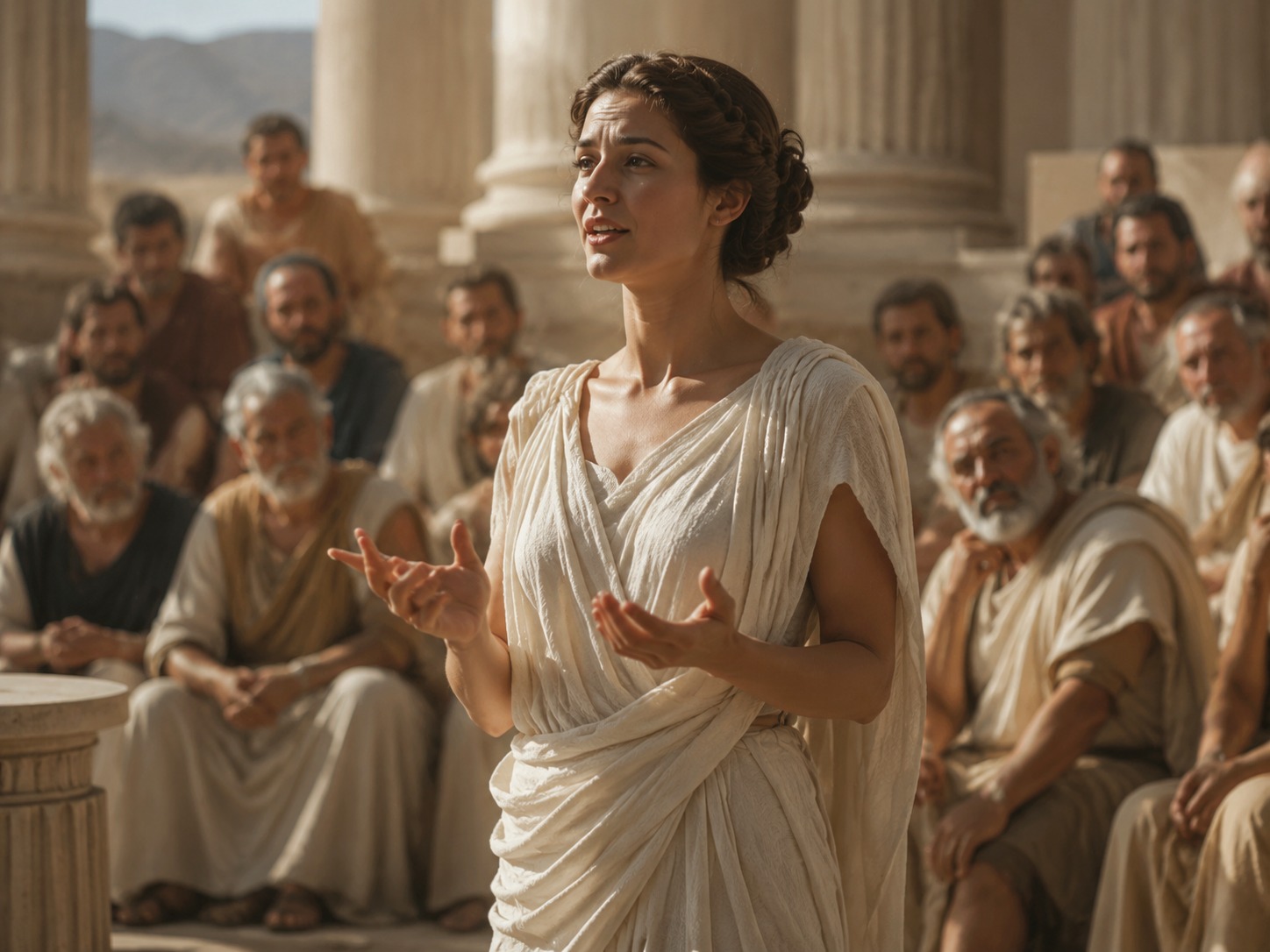
Women who engage in public speaking are seen as “freakish androgynes”, argued classics professor Mary Beard in her recent London Review of Books speech at the British Library. Throughout the centuries we have come to believe that public speaking is men’s business, Professor Beard said, citing Homer’s Odyssey and referring to the likes of Aristotle and Cicero.
However, Aristotle and Cicero had female contemporaries who are often overlooked, such as the philosophers Theano, Hypatia and Hipparchia. Professor Beard makes an important contribution in analysing how voices have been silenced, but let us not remain silent about examples of female authority in antiquity.
Theano was an associate of Pythagoras in the sixth century BC, Hipparchia was a Cynic philosopher around 350 BC, and Hypatia was head of the Platonist school at Alexandria around 400 AD and a renowned philosopher, astronomer and mathematician.
“In speech articulate and logical, in her actions prudent and public-spirited, and the rest of the city gave her suitable welcome and accorded respect,” wrote the philosopher Damascius of Hypatia. The writings of her student Synesius indicate that Hypatia’s achievements included the construction of an astronomical instrument that could measure the position of planets; it would be in use until the 19th century. Strongly influenced by Plato’s ideas, Hypatia discussed the difference between the material world and that of the mind and spirit. “The lady made appearances around the centre of the city, expounding in public to those willing to listen on Plato or Aristotle,” wrote Damascius.
Her public profile brought her influence and honour in Alexandria, the third-largest city in the Roman empire, where those in power regularly sought out her advice. Hypatia was known for her teachings as well as her great beauty, which somewhat contradicts Professor Beard’s line of thought that women had to imitate attributes of maleness to assert authority in public speaking.
If we search for “philosopher” on Google Images, we find pictures of elderly dead white men with beards. But, over the last year the image of the philosopher has received some new attention. The New York Times ran a series on Women in Philosophy to debate the obstacles women face in academic philosophy and discuss new solutions. About 20 per cent of philosophy professors in the UK and US are women and the number is growing.
When it comes to representation, Tumblr blogs have become a popular way to challenge stereotypes. Students of colour at Harvard and Oxbridge have created photo campaigns on Tumblr to highlight the prejudices they face. A group of philosophy scholars created the “Looks Philosophical” Tumblr. Posting pictures of themselves, they show that philosophers come in a range of genders, colours, sizes, classes, ages and “levels of tweediness”.
Why should we care about the image of the philosopher? Because a person can be perceived as less apt at philosophy if he or she doesn’t fit the stereotype. In the same vein those who don’t fit the picture might question their own ability to contribute to philosophy. That is why it is important to rebrand the image of philosophers, and pay attention to those women who did have a public voice in ancient times.