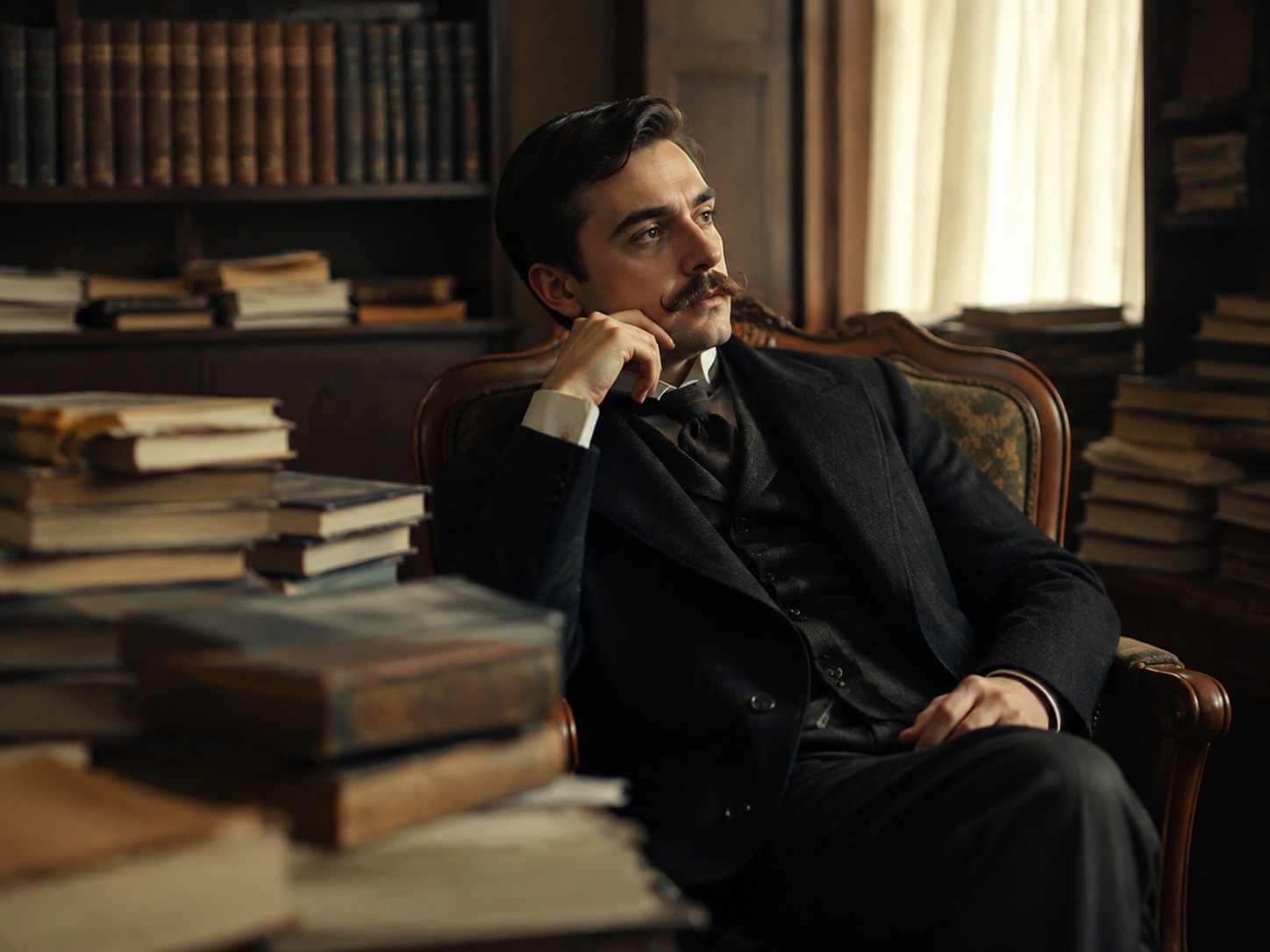
Looking for Proust
Counterpoints Literature
25/02/2014
Marcel Proust: As courageous as his hero
Longtemps, je me suis couché de bonne heure. So reads the elegant graffiti along a corridor wall at JW3, North London’s new Jewish cultural centre, claiming its author, Marcel Proust, as one of the community. Although Proust may have had ambivalent feelings towards his own Jewishness (and that of others), JW3 is an open-minded sort of place and clearly hopes to extend its welcome beyond the clan. On the other hand, Proust’s very reluctance to define himself as a Jew and even less as a Jewish writer, preferring to address the universality of human experience, may be the most Jewish thing of all about him, as a 20th-century intellectual.
JW3 opened its doors in 2013, the centenary of the publication (by Proust himself) of the first volume of what would become À la recherche du temps perdu. That volume, Du côté de chez Swann, would change the way we thought about fiction.
I and a group of friends have just started a two-year project to read the whole thing. Some of us will read in French and others mainly in English. What will we find out in the course of our literary journey? We know that we are ourselves as diverse as Proust’s creations: men and women, Jews and Gentiles, some leaning left and others right, and all no doubt respectful of each other’s sexuality. I expect we will talk about music, painting and writing; about language, and specifically those two most beautiful and mutually contrasting and complementary languages, English and French; about patriotism and politics, particularly perhaps the Dreyfus affair; about love and jealousy, lust and disgust; about death and the sadness of things; maybe, most of all, about how nothing is ever just what it seems.
Robert Harris’s latest novel, An Officer and a Spy, tells the story of the Dreyfus affair through the eyes of Georges Picquart, the man who unwittingly, almost reluctantly, uncovered the shabby conspiracy and wouldn’t let it drop. Proust makes a fleeting appearance. He sends Picquart his work Les Plaisirs et les Jours to read in prison. In fact, Picquart was Proust’s hero; he considered him to be the modern Socrates. And France has found it hard to be friendly to Socratic figures. The Dreyfus affair followed in the wake of the crushing humiliation of defeat in the Franco-Prussian war. I don’t think it’s an exaggeration to say that France has not fully recovered from either.
In 1897 Edmond Rostand put on his play Cyrano de Bergerac, convinced it was doomed to failure; it had a huge success, partly attributed to its feelgood factor, the balm it provided for wounded French pride after the 1870 defeat and the shame of the Dreyfus affair. Rostand was a Dreyfusard and Cyrano himself may be said to be a Picquart-like figure, brave and sensitive, a soldier, poet and philosopher, stubborn fighter for truth.
Cyrano, Picquart — and Proust? Really? Proust the hypochondriac in the cork-lined room, Proust the society butterfly, Proust the aesthete, the homosexual, the not-quite Jew, neither fish, fowl nor good red herring? Yes: because Proust exerted himself to defend Dreyfus, Picquart and Zola, and the Dreyfus affair runs through the novel. But even more because, in a time that sought for certainties and a country that never found it easy to accept criticism (and perhaps still doesn’t), Proust’s novel was an act of bravery as well as literary prowess. In his recognition of memory’s ambiguity and his refusal to define himself and others, he was as courageously independent as his hero.
Tags
What to read next

The End of the Dance
Influenced by Proust, Anthony Powell shared more than a mere interest in memory with the French literary master

Laurie Lee’s Ladies
Uncovering the truth from the author’s legend

Russian Renaissance
Fresh translations of lesser-known Russian literature are opening up new horizons
Counterpoints Literature Russia
standpoint-logo
Why Remoaners should back Boris
“Boris, ironically, now offers Remoaners the best chance of a soft Brexit, or at least a sensible one. And to those who want a second referendum—’the people’s vote’—there may even be a chance of that too.”

On the road
“In the summer of 1980, in the grip of some Kerouac-ish fantasy, I opted to hitch-hike from Laredo to New York”

Discovering the Great War of China
A third of a million Chinese labourers helped the Allies defeat the Kaiser, but their huge unsung contribution ended in betrayal