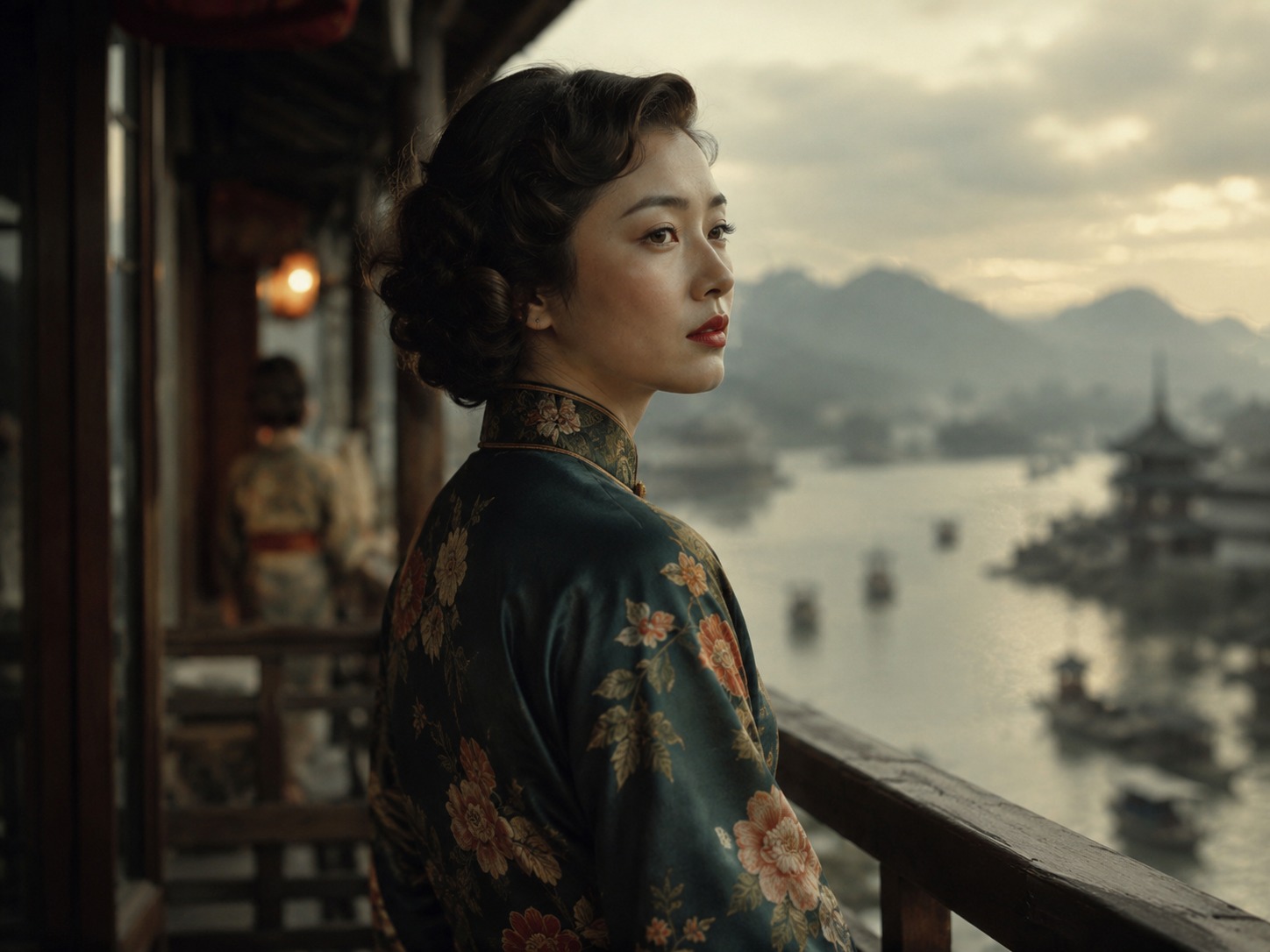
This novel is an extraordinary performance, a richly-flavoured exotic stew, a clever piece of kaleidoscopic ventriloquism. Set mainly in China and Japan, it ranges in time from the ’20s to the ’90s. At its centre is Yamaguchi Yoshiko (also known as Shirley Yamaguchi, Li Xianglou or Ri Koran). She is a “real” person, and on a page at the back, Ian Buruma acknowledges that he has drawn on interviews with this legendary actress, and on her memoirs, published in Japanese.
Buruma is best known as a brilliant journalist and cultural commentator who has specialised in Asia, particularly Japan. The life of Yamaguchi Yoshiko encompasses a number of the ways in which Japan’s view of the world, and of itself, has changed over a period of 80-odd years. He very acutely uses her as someone seen and described and judged by different people – assigning a different narrator (and thus a different viewpoint) to each of the novel’s three sections.
First, there is Sato Daisuke, brought up in the north of Japan, who finds himself in the ’30s in Japan-dominated Mukden, running the Sato Special Services Bureau for New Asian Culture: “Politics was part of my job, but culture was my real domain; and by far the most pleasant task, certainly for me the most important, was to find local talent for Manchukuo broadcasting and motion picture companies.” (Without strain, Buruma registers the self-satisfied tone of the man.) Sato helps promote Yoshiko as an actress, whose appeal is beyond political boundaries, and who is ambiguous in her “Chinese-ness” and “Japanese-ness”.
Then there is Sidney Vanoven, an American who arrives in Occupied Japan in 1946, and who becomes movie critic for a local English-language paper. He sees a popular film that Yoshiko made in 1940, China Nights, and falls under her spell – though he is strenuously gay, observing that “in Ohio, I could be arrested for what I do. In Tokyo, I am free to do as I please”. Into Vanoven’s narrative come several other “real” people – Isamu Noguchi is for a time married to Yoshiko, and such characters as Truman Capote make appearances. Vanoven is pretty clearly based on Donald Richie (whom Buruma, in that page of acknowledgements, calls his “mentor”). Having known Richie as a friend for over 50 years, I can confirm that Vanoven is a convincing portrait.
Finally, there is the strangest narrator of the trio, another Sato, a member of the so-called Japanese United Red Army, “the victors of the battle at Lydda Airport”, now a prisoner outside Beirut. He, too, has known Yoshiko, who seems sympathetic to his cause, and he finds “images flickering inside my head, as though my brain were a kind of cinema”.
In fact, the whole of this densely-furnished novel is dominated by the powerful drug of the cinema. It strikes me that Buruma must have seen more bad films than can have been good for him; but his touch is so convincing that it doesn’t matter.
Part of his strength is that he is well aware of things that many people don’t want to know or acknowledge, such as the degree of self-deception there was, and still is, over political and racial matters: for example, Sato Daisuke’s bland conviction that “we had made errors, and caused a great deal of inconvenience to the Chinese… But that is inevitable in times of great historical change”.
The China Lover itself cries out to be made into a film. I hope that things are moving in that direction.
YARPP Thumbnails